 , 74, 9, 25], 74, 9, 25].
Kayo et al. [40] showed that the one-point log-normal PDF
 and the over-density
  ). The above function is characterized by a single
parameter
). The above function is characterized by a single
parameter  which is related to the variance of
  . Since we use
  to represent the density fluctuation
field smoothed over
to represent the density fluctuation
field smoothed over  , its variance is computed from its power spectrum
  explicitly as
Here we use subscripts “lin” and “nl” to distinguish the variables corresponding to the primordial (linear)
and the evolved (nonlinear) density fields, respectively. Then
explicitly as
Here we use subscripts “lin” and “nl” to distinguish the variables corresponding to the primordial (linear)
and the evolved (nonlinear) density fields, respectively. Then  depends on the smoothing scale
  alone and is given by
Given a set of cosmological parameters, one can compute
alone and is given by
Given a set of cosmological parameters, one can compute  and thus
  very accurately using a
fitting formula for
very accurately using a
fitting formula for  (see, e.g., [67]). In this sense, the above log-normal PDF is completely specified
without any free parameter.
(see, e.g., [67]). In this sense, the above log-normal PDF is completely specified
without any free parameter.
Figure 3 plots the one-point PDFs computed from cosmological
  -body simulations in SCDM,
LCDM, and OCDM (for Standard, Lambda, and Open CDM) models, respectively [36, 40]. The
simulations employ
-body simulations in SCDM,
LCDM, and OCDM (for Standard, Lambda, and Open CDM) models, respectively [36, 40]. The
simulations employ  dark matter particles in a periodic comoving cube
  . The
density fields are smoothed over Gaussian (left panels) and Top-hat (right panels) windows with different
smoothing lengths:
. The
density fields are smoothed over Gaussian (left panels) and Top-hat (right panels) windows with different
smoothing lengths:  ,
,  , and
, and  . Solid lines show the log-normal PDFs
adopting the value of
. Solid lines show the log-normal PDFs
adopting the value of  directly evaluated from simulations (shown in each panel). The agreement
between the log-normal model and the simulation results is quite impressive. A small deviation is noticeable
only for
directly evaluated from simulations (shown in each panel). The agreement
between the log-normal model and the simulation results is quite impressive. A small deviation is noticeable
only for  .
.

 (cyan),
  (red), and
  (green). The
solid and long-dashed lines represent the log-normal PDF adopting
(green). The
solid and long-dashed lines represent the log-normal PDF adopting  calculated directly from
the simulations and estimated from the nonlinear fitting formula of [67], respectively. (Figure taken
from [40].)
calculated directly from
the simulations and estimated from the nonlinear fitting formula of [67], respectively. (Figure taken
from [40].) From an empirical point of view, Hubble [34] first noted that the galaxy distribution in angular cells on
the celestial sphere may be approximated by a log-normal distribution, rather than a Gaussian.
Theoretically the above log-normal function may be obtained from the one-to-one mapping between the
linear random-Gaussian and the nonlinear density fields [9]. We define a linear density field  smoothed
over
smoothed
over  obeying the Gaussian PDF,
 from
from  as
the PDF for
as
the PDF for  is simply given by
 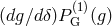 , which reduces to Equation (80
 ).
).
At this point, the transformation (85) is nothing but a mathematical procedure to relate the Gaussian
and the log-normal functions. Thus there is no physical reason to believe that the new field  should be
regarded as a nonlinear density field evolved from
should be
regarded as a nonlinear density field evolved from  even in an approximate sense. In fact it is physically
unacceptable since the relation, if taken at face value, implies that the nonlinear density field is
completely determined by its linear counterpart locally. We know, on the other hand, that
the nonlinear gravitational evolution of cosmological density fluctuations proceeds in a quite
nonlocal manner, and is sensitive to the surrounding mass distribution. Nevertheless the fact that
the log-normal PDF provides a good fit to the simulation data, empirically implies that the
transformation (85) somehow captures an important aspect of the nonlinear evolution in the real
Universe.
even in an approximate sense. In fact it is physically
unacceptable since the relation, if taken at face value, implies that the nonlinear density field is
completely determined by its linear counterpart locally. We know, on the other hand, that
the nonlinear gravitational evolution of cosmological density fluctuations proceeds in a quite
nonlocal manner, and is sensitive to the surrounding mass distribution. Nevertheless the fact that
the log-normal PDF provides a good fit to the simulation data, empirically implies that the
transformation (85) somehow captures an important aspect of the nonlinear evolution in the real
Universe.
 |
 |
 |
| http://www.livingreviews.org/lrr-2004-8 |
© Max Planck Society and the author(s)
Problems/comments to |
![1 [ {ln(1 + δ) + σ2∕2}2] 1 P(L1N)(δ) = ∘------exp − ----------2---1----- ----- (80 ) 2πσ21 2σ1 1 + δ](article243x.gif)

![σ2(R ) = ln [1 + σ2 (R )]. (82 ) 1 nl](article254x.gif)


