 ]]. We use the
  -body simulation data of
 again for this purpose [36]. We select density peaks with the threshold of the peak
height
again for this purpose [36]. We select density peaks with the threshold of the peak
height  = 1.0, 2.0, and 3.0. As for the dark matter halos, these are identified using the standard
friend-of-friend algorithm with a linking length of 0.2 in units of the mean particle separation. We select
halos of mass larger than the threshold
= 1.0, 2.0, and 3.0. As for the dark matter halos, these are identified using the standard
friend-of-friend algorithm with a linking length of 0.2 in units of the mean particle separation. We select
halos of mass larger than the threshold  ,
,  , and
, and
 .
.
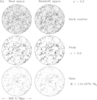
Figures 5 and 6 depict the distribution of dark matter particles (upper panel), peaks (middle
panel), and halos (lower panel) in the LCDM model at
and 6 depict the distribution of dark matter particles (upper panel), peaks (middle
panel), and halos (lower panel) in the LCDM model at  and
and  within a circular
slice (comoving radius of
within a circular
slice (comoving radius of  and thickness of
  ). We locate a fiducial
observer in the center of the circle. Then the comoving position vector
). We locate a fiducial
observer in the center of the circle. Then the comoving position vector  for a particle with a
comoving peculiar velocity
for a particle with a
comoving peculiar velocity  at a redshift
  is observed at the position s in redshift space:
 is the Hubble parameter at
  . The right panels in Figures 5 and 6 plot the observed
distribution in redshift space, where the redshift-space distortion is quite visible: The coherent velocity field
enhances the structure perpendicular to the line-of-sight of the observer (squashing) while the virialized
clump becomes elongated along the line-of-sight (finger-of-God).
. The right panels in Figures 5 and 6 plot the observed
distribution in redshift space, where the redshift-space distortion is quite visible: The coherent velocity field
enhances the structure perpendicular to the line-of-sight of the observer (squashing) while the virialized
clump becomes elongated along the line-of-sight (finger-of-God).

 in real (left panels) and redshift (right
panels) spaces around the fiducial observer at the center: dark matter particles (top panels), peaks
with
in real (left panels) and redshift (right
panels) spaces around the fiducial observer at the center: dark matter particles (top panels), peaks
with  (middle panels), and halos with
  (bottom panels) in the LCDM
model. The thickness of those slices is
(bottom panels) in the LCDM
model. The thickness of those slices is  . (Figure taken from [86].)
 We use two-point correlation functions to quantify stochasticity and nonlinearity in biasing of peaks and
halos, and explore the signature of the redshift-space distortion. Since we are interested in the
relation of the biased objects and the dark matter, we introduce three different correlation
functions: the auto-correlation functions of dark matter and the objects,  and
and  , and their
cross-correlation function
, and their
cross-correlation function  . In the present case, the subscript o refers to either h (halos) or
 (peaks). We also use the superscripts R and S to distinguish quantities defined in real
and redshift spaces, respectively. We estimate those correlation functions using the standard
pair-count method. The correlation function
(peaks). We also use the superscripts R and S to distinguish quantities defined in real
and redshift spaces, respectively. We estimate those correlation functions using the standard
pair-count method. The correlation function  is evaluated under the distant-observer
approximation.
is evaluated under the distant-observer
approximation.
Those correlation functions are plotted in Figures 7 and 8 for peaks and halos, respectively. The
correlation functions of biased objects generally have larger amplitudes than those of mass. In
nonlinear regimes ( ) the finger-of-God effect suppresses the amplitude of
  relative to
 , while
  is larger than
  in linear regimes (
 ) due to the coherent velocity
field.
) due to the coherent velocity
field.

 (upper panels) and (b)
  (lower panels). Different symbols indicate the results in real space (open squares for
  , filled
triangles for
, filled
triangles for  , open circles for
  , and crosses for dark matter), while different curves
indicate those in redshift space (dashed for
, and crosses for dark matter), while different curves
indicate those in redshift space (dashed for  , dot-dashed for
  , solid for
  , and
dotted for dark matter). (Figure taken from [86].)
, and
dotted for dark matter). (Figure taken from [86].) , but for a halo model, again for (a)
  (upper panels) and (b)
 (lower panels): Open squares and dashed lines for
  , filled triangles and
dot-dashed lines for
, filled triangles and
dot-dashed lines for  , open circles and solid lines for
  ,
and crosses and dotted lines for dark matter. For the SCDM model, we only plot the correlation
functions with
,
and crosses and dotted lines for dark matter. For the SCDM model, we only plot the correlation
functions with  and
and  . (Figure taken from [86].)
 |
 |
 |
| http://www.livingreviews.org/lrr-2004-8 |
© Max Planck Society and the author(s)
Problems/comments to |

 . (Figure taken from