 ]].
]].
In an apparent-magnitude limited catalogue of galaxies, the average number density of galaxies decreases with distance because only increasingly bright galaxies are included in the sample at larger distance. With the large redshift surveys it is possible to avoid this systematic change in both density and galaxy luminosity by constructing volume-limited samples of galaxies, with cuts on both absolute-magnitude and redshift. This is in particular useful for analyses such as MF and was carried out in the analysis shown here.
Figure 31 shows the MFs as a function of
  defined from the volume fraction [26]:
 , for a
Gaussian random field with r.m.s. density fluctuations
, for a
Gaussian random field with r.m.s. density fluctuations  . If the evolved density field may
approximately have a good one-to-one correspondence with the initial random-Gaussian field, then
this transformation removes the effect of evolution of the PDF of the density field. Under this
assumption, the MFs as a function of volume fraction would be sensitive only to the topology of
the isodensity contours rather than evolution with time of the density threshold assigned to a
contour. While the limitations of the approximation of monotonicity in the relation between
initial and evolved density fields are well recognized [40], we plot the result in this way for
simplicity.
. If the evolved density field may
approximately have a good one-to-one correspondence with the initial random-Gaussian field, then
this transformation removes the effect of evolution of the PDF of the density field. Under this
assumption, the MFs as a function of volume fraction would be sensitive only to the topology of
the isodensity contours rather than evolution with time of the density threshold assigned to a
contour. While the limitations of the approximation of monotonicity in the relation between
initial and evolved density fields are well recognized [40], we plot the result in this way for
simplicity.
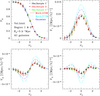
 for
for  for SDSS data. Averaged MFs of the
mock samples are plotted for LCDM (solid lines) and SCDM (long dashed lines). Gaussian model
predictions (see Equations (112
for SDSS data. Averaged MFs of the
mock samples are plotted for LCDM (solid lines) and SCDM (long dashed lines). Gaussian model
predictions (see Equations (112 , 113, 114, 115)) are also plotted with short dashed lines. The results
favor the LCDM model with random–Gaussian initial conditions. (Figure taken from [32].)
, 113, 114, 115)) are also plotted with short dashed lines. The results
favor the LCDM model with random–Gaussian initial conditions. (Figure taken from [32].) The good match between the observed MFs and the mock predictions based on the LCDM model with
the initial random-Gaussianity, as illustrated in Figure 31, might be interpreted to imply that the
primordial Gaussianity is confirmed. A more conservative interpretation is that, given the size of the
estimated uncertainties, these data do not provide evidence for initial non-Gaussianity, i.e., the data are
consistent with primordial Gaussianity. Unfortunately, due to the statistical limitation of the current SDSS
data, it is not easy to put a more quantitative statement concerning the initial Gaussianity. Moreover, in
order to go further and place more quantitative constraints on primordial Gaussianity with
upcoming data, one needs a more precise and reliable theoretical model for the MFs, which
properly describes the nonlinear gravitational effect possibly as well as galaxy biasing beyond the
simple mapping on the basis of the volume fraction. In fact, galaxy biasing is a major source of
uncertainty for relating the observed MFs to those obtained from the mock samples for dark
matter distributions. If LCDM is the correct cosmological model, the good match of the MFs
for mock samples from the LCDM simulations to the observed SDSS MFs may indicate that
nonlinearity in the galaxy biasing is relatively small, at least small enough that it does not
significantly affect the MFs (the MFs as a function of  remain unchanged for the linear
biasing).
remain unchanged for the linear
biasing).
 |
 |
 |
| http://www.livingreviews.org/lrr-2004-8 |
© Max Planck Society and the author(s)
Problems/comments to |
