 ]]. Using cosmological
  -body simulations in SCDM and
  -CDM models, they generated
light-cone samples as follows: First, they adopt a distance observer approximation and assume that the
line-of-sight direction is parallel to the
-CDM models, they generated
light-cone samples as follows: First, they adopt a distance observer approximation and assume that the
line-of-sight direction is parallel to the  -axis regardless of its
  position. Second,
they periodically duplicate the simulation box along the
position. Second,
they periodically duplicate the simulation box along the  -direction so that at a redshift
 , the position and velocity of those particles locating within an interval
  are
dumped, where
are
dumped, where  is determined by the output time-interval of the original
  -body
simulation. Finally they extract five independent (non-overlapping) cone-shape samples with
the angular radius of 1 degree (the field-of-view of
-body
simulation. Finally they extract five independent (non-overlapping) cone-shape samples with
the angular radius of 1 degree (the field-of-view of  degree
 ). In this manner, they have
generated mock data samples on the light-cone continuously extending up to
). In this manner, they have
generated mock data samples on the light-cone continuously extending up to  (relevant for
galaxy samples) and
(relevant for
galaxy samples) and  (relevant for QSO samples) from the small and large boxes,
respectively.
(relevant for QSO samples) from the small and large boxes,
respectively.
The two-point correlation function is estimated by the conventional pair-count adopting the following estimator [43]:
The comoving separation  of two objects located at
  and
and  with an angular separation
  is given by
 and
and  .
.
In redshift space, the observed redshift  for each object differs from the “real” one
  due to
the velocity distortion effect:
due to
the velocity distortion effect:
 is the line of sight relative peculiar velocity between the object and the observer in
physical units. Then the comoving separation
is the line of sight relative peculiar velocity between the object and the observer in
physical units. Then the comoving separation  of two objects in redshift space is computed as
where
of two objects in redshift space is computed as
where  and
and  .
.
In properly predicting the power spectra on the light-cone, the selection function should be
specified. For galaxies, we adopt a B-band luminosity function of the APM galaxies fitted to the
Schechter function [44]. For quasars, we adopt the B-band luminosity function from the 2dF
QSO survey data [7]. To compute the B-band apparent magnitude from a quasar of absolute
magnitude  at
at  (with the luminosity distance
  ), we applied the K-correction,
 (we use
  ). In practice, we adopt the galaxy selection
function
). In practice, we adopt the galaxy selection
function  with
with  and
and  for the small box realizations, and the QSO
selection function
for the small box realizations, and the QSO
selection function  with
with  and
and  for the large box realizations.
We do not introduce the spatial biasing between selected particles and the underlying dark
matter.
for the large box realizations.
We do not introduce the spatial biasing between selected particles and the underlying dark
matter.
Figures 14 and 15 show the two-point correlation functions in SCDM and
  -CDM, respectively,
taking account of the selection functions. It is clear that the simulation results and the predictions are in
good agreement.
-CDM, respectively,
taking account of the selection functions. It is clear that the simulation results and the predictions are in
good agreement.
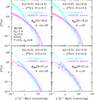
 (upper panels) and
 (lower panels). Left panels: with selection function whose shape is the same as that
of the B-band magnitude limit of 19 for galaxies (upper) and 21 for QSOs (lower); right panels:
randomly selected
(lower panels). Left panels: with selection function whose shape is the same as that
of the B-band magnitude limit of 19 for galaxies (upper) and 21 for QSOs (lower); right panels:
randomly selected  particles from the particles in the results from the left panels. (Figure
taken from [28].)
particles from the particles in the results from the left panels. (Figure
taken from [28].) |
 |
 |
| http://www.livingreviews.org/lrr-2004-8 |
© Max Planck Society and the author(s)
Problems/comments to |





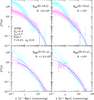
 -CDM model. (Figure taken from