 ]]
developed a theoretical framework to describe the geometrical distortion effect (cosmological redshift
distortion) in the two-point correlation function and the power spectrum of distant objects,
respectively. Certain studies were less optimistic than others about the possibility of measuring this
Alcock–Paczynski effect. For example, Ballinger, Peacock, and Heavens [3] argued that the
geometrical distortion could be confused with the dynamical redshift distortions caused by
peculiar velocities and characterized by the linear theory parameter
]]
developed a theoretical framework to describe the geometrical distortion effect (cosmological redshift
distortion) in the two-point correlation function and the power spectrum of distant objects,
respectively. Certain studies were less optimistic than others about the possibility of measuring this
Alcock–Paczynski effect. For example, Ballinger, Peacock, and Heavens [3] argued that the
geometrical distortion could be confused with the dynamical redshift distortions caused by
peculiar velocities and characterized by the linear theory parameter  . Matsubara
and Szalay [55, 56] showed that the typical SDSS and 2dF samples of normal galaxies at low
redshift (
. Matsubara
and Szalay [55, 56] showed that the typical SDSS and 2dF samples of normal galaxies at low
redshift ( ) have sufficiently low signal-to-noise, but they are too shallow to detect the
Alcock–Paczynski effect. On the other hand, the quasar SDSS and 2dFGRS surveys are at a useful
redshift, but they are too sparse. A more promising sample is the SDSS Luminous Red Galaxies
survey (out to redshift
) have sufficiently low signal-to-noise, but they are too shallow to detect the
Alcock–Paczynski effect. On the other hand, the quasar SDSS and 2dFGRS surveys are at a useful
redshift, but they are too sparse. A more promising sample is the SDSS Luminous Red Galaxies
survey (out to redshift  ) which turns out to be optimal in terms of both depth and
density.
) which turns out to be optimal in terms of both depth and
density.
While this analysis is promising, it remains to be tested if non-linear clustering and complicated biasing (which is quite plausible for red galaxies) would not ‘contaminate’ the measurement of the equation of state. Even if the Alcock–Paczynski test turns out to be less accurate than other cosmological tests (e.g., CMB and SN Ia), the effect itself is an interesting and important ingredient in analyzing the clustering pattern of galaxies at high redshifts. We shall now present the formalism for this effect.
Due to a general-relativistic effect through the geometry of the Universe, the observable separations
perpendicular and parallel to the line-of-sight direction,  and
and  , are
mapped differently to the corresponding comoving separations in real space
, are
mapped differently to the corresponding comoving separations in real space  and
and  :
:
 being the angular diameter distance. The difference between
  and
and  generates an
apparent anisotropy in the clustering statistics, which should be isotropic in the comoving space. Then the
power spectrum in cosmological redshift space
generates an
apparent anisotropy in the clustering statistics, which should be isotropic in the comoving space. Then the
power spectrum in cosmological redshift space  is related to
  defined in the comoving
redshift space as
where the first factor comes from the Jacobian of the volume element
defined in the comoving
redshift space as
where the first factor comes from the Jacobian of the volume element  , and
, and  and
and
 are the wavenumber perpendicular and parallel to the line-of-sight direction.
Using Equation (131 ), Equation (156) reduces to
Figure 16 shows anisotropic power spectra
  . As specific examples, we
consider SCDM, LCDM, and OCDM models, which have
. As specific examples, we
consider SCDM, LCDM, and OCDM models, which have  ,
,
 , and
, and  , respectively. Clearly the linear theory predictions
(
, respectively. Clearly the linear theory predictions
( ; top panels) are quite different from the results of
  -body simulations (bottom panels),
indicating the importance of the nonlinear velocity effects (
-body simulations (bottom panels),
indicating the importance of the nonlinear velocity effects ( computed according to [58]; middle
panels).
computed according to [58]; middle
panels).
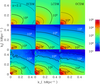
 . (Figure taken
from [46].)
. (Figure taken
from [46].)Next we decompose the power spectrum into harmonics,
where are the
  -th order Legendre polynomials. Similarly, the two-point correlation function is
decomposed as
using the direction cosine
-th order Legendre polynomials. Similarly, the two-point correlation function is
decomposed as
using the direction cosine  between the separation vector and the line-of-sight. The above multipole
moments satisfy the following relations:
with
between the separation vector and the line-of-sight. The above multipole
moments satisfy the following relations:
with  being spherical Bessel functions. Substituting
  in Equation (159) yields
 , and then
  can be computed from Equation (161).
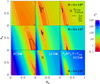
 -
- plane from the
  -analysis of the monopole
and quadrupole moments of the power spectrum in the cosmological redshift space at
-analysis of the monopole
and quadrupole moments of the power spectrum in the cosmological redshift space at  . We
randomly selected
. We
randomly selected  (upper panels),
  (middle panels), and
  (lower panels) particles from
  -body simulation. The value of
  is adopted from the cluster
abundance. (Figure taken from [46].)
is adopted from the cluster
abundance. (Figure taken from [46].) A comparison of the monopoles and quadrupoles from simulations and model predictions exhibits how
the results are sensitive to the cosmological parameters, which in turn may put potentially useful
constraints on  . Figure 17 indicates the feasibility, which interestingly results in a constraint
fairly orthogonal to that from the supernovae Ia Hubble diagram.
. Figure 17 indicates the feasibility, which interestingly results in a constraint
fairly orthogonal to that from the supernovae Ia Hubble diagram.
 |
 |
 |
| http://www.livingreviews.org/lrr-2004-8 |
© Max Planck Society and the author(s)
Problems/comments to |
![x (z) = x cz∕ [H (1 + z)d (z)] ≡ x ∕c (z), (154 ) s⊥ ⊥ 0 A ⊥ ⊥ xs∥(z) = x∥H (z)∕H0 ≡ x∥∕c∥(z), (155 )](article674x.gif)

![2 ( ∘ ----[---------]---- ) (CRD ) ---b-(z-)--- (R) --ks-- --1-- 2 P (ks,μk;z ) = c⊥(z)2c∥(z )Pmass c⊥(z) 1 + η(z)2 − 1 μk;z × ( ) [ ( 1 ) ]−2 [ ( 1 + β(z) ) ]2 k2μ2σ2 −1 1 + ----2 − 1 μ2k 1 + -----2---− 1 μ2k 1 + -s2k-P- , (157 ) η (z ) η(z) 2c∥(z)](article684x.gif)



