6.3 Luminosity and spectral-type dependence of galaxy clustering
Although biasing was commonly neglected until the early 1980s, it has become evident
observationally that on scales 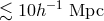 different galaxy populations exhibit different clustering
amplitudes, the so-called morphology-density relation [16]. As discussed in Section 4, galaxy biasing
is naturally predicted from a variety of theoretical considerations as well as direct numerical
simulations [37, 59, 15, 87, 86, 103]. Thus, in this Section we summarize the extent to which the galaxy
clustering is dependent on the luminosity, spectral-type, and color of the galaxy sample from the 2dFGRS
and SDSS.
different galaxy populations exhibit different clustering
amplitudes, the so-called morphology-density relation [16]. As discussed in Section 4, galaxy biasing
is naturally predicted from a variety of theoretical considerations as well as direct numerical
simulations [37, 59, 15, 87, 86, 103]. Thus, in this Section we summarize the extent to which the galaxy
clustering is dependent on the luminosity, spectral-type, and color of the galaxy sample from the 2dFGRS
and SDSS.
6.3.1 2dFGRS: Clustering per luminosity and spectral type
Madgwick et al. [45 ] applied the Principal Component Analysis to compress each galaxy spectrum into one
quantity,
] applied the Principal Component Analysis to compress each galaxy spectrum into one
quantity,  . Qualitatively,
  is an indicator of the ratio of the present to the past star
formation activity of each galaxy. This allows one to divide the 2dFGRS into
is an indicator of the ratio of the present to the past star
formation activity of each galaxy. This allows one to divide the 2dFGRS into  -types, and to
study, e.g., luminosity functions and clustering per type. Norberg et al. [61] showed that, at all
luminosities, early-type galaxies have a higher bias than late-type galaxies, and that the biasing
parameter, defined here as the ratio of the galaxy to matter correlation function
-types, and to
study, e.g., luminosity functions and clustering per type. Norberg et al. [61] showed that, at all
luminosities, early-type galaxies have a higher bias than late-type galaxies, and that the biasing
parameter, defined here as the ratio of the galaxy to matter correlation function  varies as
  . Figure 25 indicates that for
  galaxies, the real space
correlation function amplitude of
galaxies, the real space
correlation function amplitude of  early-type galaxies is
  higher than that of late-type
galaxies.
higher than that of late-type
galaxies.
Figure 26 shows the redshift-space correlation function in terms of the line-of-sight and perpendicular to
the line-of-sight separation  . The correlation function calculated from the most passively (‘red’, for
which the present rate of star formation is less than 10% of its past averaged value) and actively (‘blue’)
star-forming galaxies. The clustering properties of the two samples are clearly distinct on scales
. The correlation function calculated from the most passively (‘red’, for
which the present rate of star formation is less than 10% of its past averaged value) and actively (‘blue’)
star-forming galaxies. The clustering properties of the two samples are clearly distinct on scales
 . The ‘red’ galaxies display a prominent finger-of-God effect and also have a higher overall
normalization than the ‘blue’ galaxies. This is a manifestation of the well-known morphology-density
relation. By fitting
. The ‘red’ galaxies display a prominent finger-of-God effect and also have a higher overall
normalization than the ‘blue’ galaxies. This is a manifestation of the well-known morphology-density
relation. By fitting  over the separation range
  for each class, it was
found that
for each class, it was
found that  ,
,  and corresponding pairwise velocity
dispersions
and corresponding pairwise velocity
dispersions  of
of  and
and  [45]. At small separations, the real
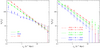
space clustering of passive galaxies is stronger than that of active galaxies: The slopes
[45]. At small separations, the real
space clustering of passive galaxies is stronger than that of active galaxies: The slopes  are
respectively 1.93 and 1.50 (see Figure 27) and the relative bias between the two classes is a declining
function of separation. On scales larger than
are
respectively 1.93 and 1.50 (see Figure 27) and the relative bias between the two classes is a declining
function of separation. On scales larger than  the biasing ratio is approaching
unity.
the biasing ratio is approaching
unity.
Another statistic was applied recently by Wild et al. [98] and Conway et al. [12], of a joint
counts-in-cells on 2dFGRS galaxies, classified by both color and spectral type. Exact linear bias is ruled out
on all scales. The counts are better fitted to a bivariate log-normal distribution. On small scales there is
evidence for stochasticity. Further investigation of galaxy formation models is required to understand the
origin of the stochasticity.
6.3.2 SDSS: Two-point correlation functions per luminosity and color
Zehavi et al. [104] analyzed the Early Data Release (EDR) sample of the SDSS 30,000 galaxies to explore
the clustering of per luminosity and color. The inferred real-space correlation function is well described by a
single power-law:  for
for  .
The galaxy pairwise velocity dispersion is
.
The galaxy pairwise velocity dispersion is  for projected separations
 . When divided by color, the red galaxies exhibit a stronger
and steeper real-space correlation function and a higher pairwise velocity dispersion than do
the blue galaxies. In agreement with 2dFGRS there is clear evidence for a scale-independent
luminosity bias at
. When divided by color, the red galaxies exhibit a stronger
and steeper real-space correlation function and a higher pairwise velocity dispersion than do
the blue galaxies. In agreement with 2dFGRS there is clear evidence for a scale-independent
luminosity bias at  . Subsamples with absolute magnitude ranges centered on
 ,
,
 , and
, and  have real-space correlation functions that are parallel power laws of slope
 with correlation lengths of approximately
  ,
,  , and
, and  ,
respectively.
,
respectively.
Figures 27 and 28 pose an interesting challenge to the theory of galaxy formation, to explain why the
correlation functions per luminosity bins have similar slope, while the slope for early type galaxies is steeper
than for late type.
6.3.3 SDSS: Three-point correlation functions and the nonlinear biasing of galaxies per luminosity and
color
Let us move next to the three-point correlation functions (3PCF) of galaxies, which are the lowest-order
unambiguous statistic to characterize non-Gaussianities due to nonlinear gravitational evolution of dark
matter density fields, formation of luminous galaxies, and their subsequent evolution. The determination of
the 3PCF of galaxies was pioneered by Peebles and Groth [70] and Groth and Peebles [27] using the Lick
and Zwicky angular catalogs of galaxies. They found that the 3PCF  obeys the hierarchical
relation:
obeys the hierarchical
relation:
with  being a constant. The value of
  in real space deprojected from these angular catalogues is
 for
for  . Subsequent analyses of redshift catalogs confirmed the hierarchical
relation, at least approximately, but the value of
. Subsequent analyses of redshift catalogs confirmed the hierarchical
relation, at least approximately, but the value of  (in redshift space) appears to be smaller,
 .
.
As we have seen in Section 6.3.2, galaxy clustering is sensitive to the intrinsic properties of the galaxy
samples under consideration, including their morphological types, colors, and luminosities. Nevertheless the
previous analyses were not able to examine those dependences of 3PCFs because of the limited
number of galaxies. Indeed Kayo et al. [39] were the first to perform the detailed analysis of
3PCFs explicitly taking account of the morphology, color, and luminosity dependence. They
constructed volume-limited samples from a subset of the SDSS galaxy redshift data, ‘Large-scale
Structure Sample 12’. Specifically they divided each volume limited sample into color subsamples of
red (blue) galaxies, which consist of 7949 (8329), 8930 (8155), and 3706 (3829) galaxies for
 ,
,  , and
, and  ,
respectively.
,
respectively.
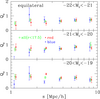
Figure 29 indicates the dimensionless amplitude of the 3PCFs of SDSS galaxies in redshift space,
for the equilateral triplets of galaxies. The overall conclusion is that  is almost scale-independent and
ranges between 0.5 and 1.0, and that no systematic dependence is noticeable on luminosity and color. This
implies that the 3PCF itself does depend on the galaxy properties since two-point correlation functions
(2PCFs) exhibit clear dependence on luminosity and color. Previous simulations and theoretical
models [82, 53, 50, 85] indicate that
is almost scale-independent and
ranges between 0.5 and 1.0, and that no systematic dependence is noticeable on luminosity and color. This
implies that the 3PCF itself does depend on the galaxy properties since two-point correlation functions
(2PCFs) exhibit clear dependence on luminosity and color. Previous simulations and theoretical
models [82, 53, 50, 85] indicate that  decreases with scale in both real and redshift spaces. This trend
is not seen in the observational results.
decreases with scale in both real and redshift spaces. This trend
is not seen in the observational results.
In order to demonstrate the expected dependence in the current samples, they compute the biasing
parameters estimated from the 2PCFs,
where the index  runs over each sample of galaxies with different colors and luminosities. The predictions
of the mass 2PCFs in redshift space,
runs over each sample of galaxies with different colors and luminosities. The predictions
of the mass 2PCFs in redshift space,  , in the
  cold dark matter model are computed
following [28].
cold dark matter model are computed
following [28].
As an illustrative example, consider a simple bias model in which the galaxy density field  for the
 -th population of galaxies is given by
If both  and
and  are constant and the mass density field
  , Equation (174) implies
that
Thus the linear bias model (
, Equation (174) implies
that
Thus the linear bias model ( ) simply implies that
  is inversely proportional to
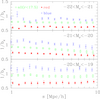
 , which is plotted in Figure 30. A comparison of Figures 29 and 30 indicates that the
biasing in the 3PCFs seems to compensate the difference of
, which is plotted in Figure 30. A comparison of Figures 29 and 30 indicates that the
biasing in the 3PCFs seems to compensate the difference of  purely due to that in the
2PCFs.
purely due to that in the
2PCFs.
Such behavior is unlikely to be explained by any simple model inspired by the perturbative expansion
like Equation (176). Rather it indeed points to a kind of regularity or universality of the clustering
hierarchy behind galaxy formation and evolution processes. Thus the galaxy biasing seems much more
complex than the simple deterministic and linear model. More precise measurements of 3PCFs and even
higher-order statistics with future SDSS datasets would be indeed valuable to gain more specific insights
into the empirical biasing model.
 indicates that for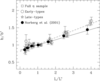
 galaxy
for the full sample and for subsamples of early and late spectra types. (Figure taken from
galaxy
for the full sample and for subsamples of early and late spectra types. (Figure taken from 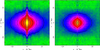
 plotted for passively (left panel) and actively
(right panel) star-forming galaxies. The line contours levels show the best-fitting model. (Figure
taken from
plotted for passively (left panel) and actively
(right panel) star-forming galaxies. The line contours levels show the best-fitting model. (Figure
taken from 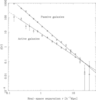
 (upper panel), and
the SDSS (EDR) projected correlation function for three volume-limited samples, with absolute
magnitude and redshift ranges as indicated and best-fitting power-law models (lower panel). (Figure
taken from
(upper panel), and
the SDSS (EDR) projected correlation function for three volume-limited samples, with absolute
magnitude and redshift ranges as indicated and best-fitting power-law models (lower panel). (Figure
taken from ![ζ(r12,r23,r31) = Qr [ξ(r12)ξ(r23) + ξ(r23)ξ(r31) + ξ(r31)ξ(r12)], (173 )](article897x.gif)