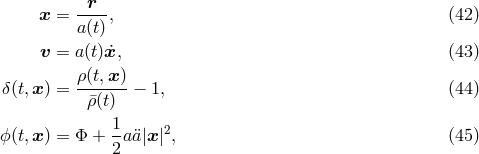
in the comoving coordinate, the peculiar velocity
  , density fluctuations
  , and the
gravitational potential
, and the
gravitational potential  which are defined as
respectively. Then Equations (39
which are defined as
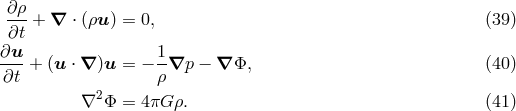
respectively. Then Equations (39 ) to (41) reduce to
where the dot and
) to (41) reduce to
where the dot and  in the above equations are the time derivative for a given
  and the spatial
derivative with respect to
and the spatial
derivative with respect to  , i.e., defined in the comoving coordinate (while those in Equations (39, 40,
41) are defined in the proper coordinate).
, i.e., defined in the comoving coordinate (while those in Equations (39, 40,
41) are defined in the proper coordinate).
A standard picture of the cosmic structure formation assumes that the initially tiny amplitude of
density fluctuation grow according to Equations (46, 47, 48). Also the Universe smoothed over
large scales approaches a homogeneous model. Thus at early epochs and/or on large scales, the
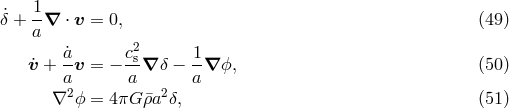
nonlinear effect is small and one can linearize those equations with respect to  and
and  :
:
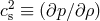 is the sound velocity squared.
As usual, we transform the above equations in  space using
 reduces to
If the signature of the third term is positive,
reduces to
If the signature of the third term is positive,  has an unstable, or, monotonically increasing solution.
This condition is equivalent to the Jeans criterion:
namely, the wavelength of the fluctuation is larger than the Jeans length
has an unstable, or, monotonically increasing solution.
This condition is equivalent to the Jeans criterion:
namely, the wavelength of the fluctuation is larger than the Jeans length  which characterizes the scale
that the sound wave can propagate within the dynamical time of the fluctuation
which characterizes the scale
that the sound wave can propagate within the dynamical time of the fluctuation  . Below the scale,
the pressure wave can suppress the gravitational instability, and the fluctuation amplitude
oscillates.
. Below the scale,
the pressure wave can suppress the gravitational instability, and the fluctuation amplitude
oscillates.
 |
 |
 |
| http://www.livingreviews.org/lrr-2004-8 |
© Max Planck Society and the author(s)
Problems/comments to |
![1 ˙δ + --∇ ⋅ [(1 + δ)v] = 0, (46 ) a ˙v + 1-(v ⋅ ∇ )v + ˙av = − 1-∇p − 1∇ ϕ, (47 ) a a ρa a ∇2ϕ = 4πG ¯ρa2δ, (48 )](article150x.gif)