 in Equations (4
 ) and (5). Clearly the necessary and sufficient
condition that the equations admit the solution of
) and (5). Clearly the necessary and sufficient
condition that the equations admit the solution of  is given by
  is time-dependent. As a digression, let us examine why Einstein once introduced the
  -term to
obtain a static cosmological solution. This is mainly important for historical reasons, but is also interesting
to observe how the operationally identical parameter (the
-term to
obtain a static cosmological solution. This is mainly important for historical reasons, but is also interesting
to observe how the operationally identical parameter (the  -term, the cosmological constant, the vacuum
energy, the dark energy) shows up in completely different contexts in the course of the development of
cosmological physics.
-term, the cosmological constant, the vacuum
energy, the dark energy) shows up in completely different contexts in the course of the development of
cosmological physics.
Consider first the case of in Equations (4) and (5). Clearly the necessary and sufficient
condition that the equations admit the solution of is given by
 on the other hand, the condition for the static solution is
yielding
Thus both
on the other hand, the condition for the static solution is
yielding
Thus both  and
and  can be positive if
In particular, if
can be positive if
In particular, if  ,
This represents the closed Universe (with positive spatial curvature), and corresponds to Einstein’s static
model.
,
This represents the closed Universe (with positive spatial curvature), and corresponds to Einstein’s static
model.
The above static model is a special case of Lemaître’s Universe model with  and
and  . For
simplicity, let us assume that the Universe is dominated by non-relativistic matter with negligible pressure,
and consider the behavior of Lemaître’s model. First we define the values of the density and the scale
factor corresponding to Einstein’s static model:
. For
simplicity, let us assume that the Universe is dominated by non-relativistic matter with negligible pressure,
and consider the behavior of Lemaître’s model. First we define the values of the density and the scale
factor corresponding to Einstein’s static model:
 is a factor of
  larger than
  . Then
and Equations (4) and (5) reduce to
For the period of
. Then
and Equations (4) and (5) reduce to
For the period of  , Equation (33) indicates that
  and the Universe is decelerating
(
and the Universe is decelerating
( ). When
  reaches
  ,
,  takes the minimum value
 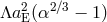 and the Universe
becomes accelerating (
and the Universe
becomes accelerating ( ). Finally the Universe approaches the exponential expansion or de Sitter
model:
). Finally the Universe approaches the exponential expansion or de Sitter
model:  . If
. If  becomes closer to unity, the minimum value reaches zero and
the expansion of the Universe is effectively frozen. This phase is called the coasting period,
and the case with
becomes closer to unity, the minimum value reaches zero and
the expansion of the Universe is effectively frozen. This phase is called the coasting period,
and the case with  corresponds to Einstein’s static model in which the coasting period
continues forever. A similar consideration for
corresponds to Einstein’s static model in which the coasting period
continues forever. A similar consideration for  indicates that the Universe starts collapsing
(
indicates that the Universe starts collapsing
( ) before
  . Thus the behavior of Lemaître’s model is crucially different if
 is larger or smaller than unity. This suggests that Einstein’s static model (
 ) is
unstable.
) is
unstable.
 |
 |
 |
| http://www.livingreviews.org/lrr-2004-8 |
© Max Planck Society and the author(s)
Problems/comments to |







![Λ ( 2αa3 ) a˙2 = -- ---E-− 3a2E + a2 , (33 ) 3 [ a ] ¨a Λ (aE )3 --= -- 1 − α --- . (34 ) a 3 a](article116x.gif)