
 can be replaced by a function (twist potential). We have already pointed
out that
can be replaced by a function (twist potential). We have already pointed
out that  , parametrizing the non-static part of the metric, enters the effective action (9)
only via the field strength,
, parametrizing the non-static part of the metric, enters the effective action (9)
only via the field strength,  . For this reason, the variational equation for
  (that
is, the off-diagonal Einstein equation) assumes the form of a source-free Maxwell equation,
By virtue of Eq. (10), the (locally defined) function
(that
is, the off-diagonal Einstein equation) assumes the form of a source-free Maxwell equation,
By virtue of Eq. (10), the (locally defined) function  is a potential for the twist one-form,
  .
In order to write the effective action (9) in terms of the twist potential
.
In order to write the effective action (9) in terms of the twist potential  , rather than the one-form
  ,
one considers
,
one considers  as a fundamental field and imposes the constraint
  with the Lagrange
multiplier
with the Lagrange
multiplier  . The variational equation with respect to
  then yields
  , which is used
to eliminate
, which is used
to eliminate  in favor of
  . One finds
  . Thus, the action (9)
becomes
where we recall that
. Thus, the action (9)
becomes
where we recall that  is the inner product with respect to the three-metric
  defined in
Eq. (8).
defined in
Eq. (8).
The action (12) describes a harmonic mapping into a two-dimensional target space, effectively coupled
to three-dimensional gravity. In terms of the complex Ernst potential  [52
[52 , 53], one has
 [
[ -equations] and the Ernst potential
  [
[ -equations]. One easily finds
 and
and  , where
  is the Laplacian with respect to
 .
.
The target space for stationary vacuum gravity, parametrized by the Ernst potential  , is a
Kähler manifold with metric
, is a
Kähler manifold with metric  (see [62] for details). By virtue of the mapping
 , is mapped into the interior of the complex unit
disc,
, is mapped into the interior of the complex unit
disc,  , with standard metric
  . By virtue of the stereographic
projection,
. By virtue of the stereographic
projection,  ,
,  , the unit disc
  is isometric to the pseudo-sphere,
 . As the three-dimensional Lorentz group,
  ,
acts transitively and isometrically on the pseudo-sphere with isotropy group
,
acts transitively and isometrically on the pseudo-sphere with isotropy group  , the target space is the coset
 42.
Using the universal covering
42.
Using the universal covering  of
of  , one can parametrize
  in
terms of a positive hermitian matrix
in
terms of a positive hermitian matrix  , defined by
Hence, the effective action for stationary vacuum gravity becomes the standard action for a
, defined by
Hence, the effective action for stationary vacuum gravity becomes the standard action for a  -model
coupled to three-dimensional gravity [139],
-model
coupled to three-dimensional gravity [139],
The simplest nontrivial solution to the vacuum Einstein equations is obtained in the static, spherically
symmetric case: For  one has
  and
and  . With respect to the general
spherically symmetric ansatz
. With respect to the general
spherically symmetric ansatz
 and
and 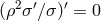 , the solution of which is the
Schwarzschild metric in the usual parametrization:
, the solution of which is the
Schwarzschild metric in the usual parametrization:  ,
,  .
.
 |
 |
 |
| http://www.livingreviews.org/lrr-1998-6 |
© Max Planck Society and the author(s)
Problems/comments to |






