We start from Einstein’s equation for the evolution of the Universe
where describes the size of the Universe,
  is the gravitational constant,
  is the present density
of the Universe,
is the present density
of the Universe,  is a measure of the curvature of space and
  is the Cosmological constant which can
be thought of as the zero energy of a vacuum. If the Cosmological term dominates (as the scalar field is
expected to at very high temperatures), then the other two terms become negligible and it is possible to
solve and find
Therefore, the inflationary theory describes an exponential expansion of space in the very early Universe.
Amplification of initial quantum irregularities then results in a spectrum of long wavelength perturbations
on scales initially bigger than the horizon size. Central to the theory of inflation is the potential
is the Cosmological constant which can
be thought of as the zero energy of a vacuum. If the Cosmological term dominates (as the scalar field is
expected to at very high temperatures), then the other two terms become negligible and it is possible to
solve and find
Therefore, the inflationary theory describes an exponential expansion of space in the very early Universe.
Amplification of initial quantum irregularities then results in a spectrum of long wavelength perturbations
on scales initially bigger than the horizon size. Central to the theory of inflation is the potential  ,
which describes the self-interaction of the scalar inflaton field
,
which describes the self-interaction of the scalar inflaton field  . Due to the unknown nature of this
potential, and the unknown parameters involved in the theory, inflationary theory is bad (at the moment)
at predicting the overall amplitude of the matter fluctuations at recombination. However, there is a
reasonable agreement that the form of the fluctuation spectrum coming out of inflation should be given by
where
. Due to the unknown nature of this
potential, and the unknown parameters involved in the theory, inflationary theory is bad (at the moment)
at predicting the overall amplitude of the matter fluctuations at recombination. However, there is a
reasonable agreement that the form of the fluctuation spectrum coming out of inflation should be given by
where  is the comoving wavenumber and
  is the ‘tilt’ of the primordial spectrum. The latter is
predicted to lie close to 1 (the case
is the ‘tilt’ of the primordial spectrum. The latter is
predicted to lie close to 1 (the case  being the Harrison–Zel’dovich, or ‘scale-invariant’
spectrum).
being the Harrison–Zel’dovich, or ‘scale-invariant’
spectrum).
An overdensity in the early Universe does not collapse under the effect of self-gravity until it enters its own particle horizon when every point within it is in causal contact with every other point. The perturbation will continue to collapse until it reaches the Jean’s length, at which time radiation pressure will oppose gravity and set up acoustic oscillations. Since overdensities of the same size will pass the horizon size at the same time, they will be oscillating in phase. These acoustic oscillations occur in both the matter field and the photon field and so will induce ‘Doppler peaks’ in the photon spectrum.
The level of the Doppler peaks in the power spectrum depend on the number of acoustic oscillations that
have taken place since entering the horizon. For overdensities that have undergone half an oscillation, there
will be a large Doppler peak (corresponding to an angular size of  1°). Other peaks occur at harmonics
of this. As the amplitude and position of the primary and secondary peaks are intrinsically determined
by the number of electron scatterers and by the geometry of the Universe, they can be used
as a test of the density parameter of baryons and dark matter, as well as other cosmological
constants.
1°). Other peaks occur at harmonics
of this. As the amplitude and position of the primary and secondary peaks are intrinsically determined
by the number of electron scatterers and by the geometry of the Universe, they can be used
as a test of the density parameter of baryons and dark matter, as well as other cosmological
constants.
Prior to the last scattering surface, the photons and matter interact on scales smaller than the horizon size. Through diffusion, the photons will travel from high density regions to low density regions ‘dragging’ the electrons with them via Compton interaction. The electrons are coupled to the protons through Coulomb interactions, and so the matter will move from high density regions to low density regions. This diffusion has the effect of damping out the fluctuations and is more marked as the size of the fluctuation decreases. Therefore, we expect the Doppler peaks to vanish at very small angular scales. This effect is known as Silk damping [83].
Another possible diffusion process is free streaming. It occurs when collisionless particles (e.g. neutrinos) move from high density to low density regions. If these particles have a small mass, then free streaming causes a damping of the fluctuations. The exact scale this occurs on depends on the mass and velocity of the particles involved. Slow moving particles will have little effect on the spectrum of fluctuations as Silk damping already wipes out the fluctuations on these scales, but fast moving, heavy particles (e.g. a neutrino with 30 eV mass), can wipe out fluctuations on larger scales corresponding to 20 Mpc today [28].
Putting this all together, we see that on large angular scales ( 2°) we expect the CMB power
spectrum to reflect the initially near scale-invariant spectrum coming out of inflation; on intermediate
angular scales we expect to see a series of peaks, and on smaller angular scales (
2°) we expect the CMB power
spectrum to reflect the initially near scale-invariant spectrum coming out of inflation; on intermediate
angular scales we expect to see a series of peaks, and on smaller angular scales ( 10 arcmin) we expect
to see a sharp decline in amplitude. These expectations are borne out in the actual calculated form of the
CMB power spectrum in what is currently the ‘standard model’ for cosmology, namely inflation together
with cold dark matter (CDM). The spectrum for this, assuming
10 arcmin) we expect
to see a sharp decline in amplitude. These expectations are borne out in the actual calculated form of the
CMB power spectrum in what is currently the ‘standard model’ for cosmology, namely inflation together
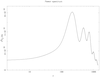
with cold dark matter (CDM). The spectrum for this, assuming  and standard values for other
parameters, is shown in Figure 2
and standard values for other
parameters, is shown in Figure 2 .
.
The quantities plotted are  , versus
  where
where  is defined via
 are standard spherical harmonics. The reason for plotting
  is that it
approximately equals the power per unit logarithmic interval in
is that it
approximately equals the power per unit logarithmic interval in  . Increasing
  corresponds to
decreasing angular scale
corresponds to
decreasing angular scale  , with a rough relationship between the two of
  radians. In terms of
the diameter of corresponding proto-objects imprinted in the CMB, a rich cluster of galaxies corresponds to
a scale of about 8 arcmin, while the angular scale corresponding to the largest scale of clustering we know
about in the Universe today corresponds to 1/2 to 1 degree. The first large peak in the power spectrum, at
radians. In terms of
the diameter of corresponding proto-objects imprinted in the CMB, a rich cluster of galaxies corresponds to
a scale of about 8 arcmin, while the angular scale corresponding to the largest scale of clustering we know
about in the Universe today corresponds to 1/2 to 1 degree. The first large peak in the power spectrum, at
 ’s near 200, and therefore angular scales near 1°, is known as the ‘Doppler’, or ‘Sakharov’, or ‘acoustic’
peak.
’s near 200, and therefore angular scales near 1°, is known as the ‘Doppler’, or ‘Sakharov’, or ‘acoustic’
peak.
As stated above, the inflationary CMB power spectrum plotted in Figure 2 is that predicted by
assuming the standard values of the cosmological parameters for a CDM model of the Universe. In order for
an experimental measurement of the angular power spectrum to be able to place constraints on
these parameters, we must consider how the shape of the predicted power spectrum varies
in response to changes in these parameters. In general, the detailed changes due to varying
several parameters at once can be quite complicated. However, if we restrict our attention to the
parameters  ,
,  and
and  , the fractional baryon density, then the situation becomes
simpler.
, the fractional baryon density, then the situation becomes
simpler.
Perhaps most straightforward is the information contained in the position of the first Doppler peak, and
of the smaller secondary peaks, since this is determined almost exclusively by the value of the total  ,
and varies as
,
and varies as  . (This behaviour is determined as mentioned above by the linear size of the
causal horizon at recombination, and the usual formula for angular diameter distance.) This means
that if we were able to determine the position (in a left/right sense) of this peak, and we were
confident in the underlying model assumptions, then we could read off the value of the total
density of the Universe. (In the case where the cosmological constant was non-zero, we would
effectively be reading off the combination
. (This behaviour is determined as mentioned above by the linear size of the
causal horizon at recombination, and the usual formula for angular diameter distance.) This means
that if we were able to determine the position (in a left/right sense) of this peak, and we were
confident in the underlying model assumptions, then we could read off the value of the total
density of the Universe. (In the case where the cosmological constant was non-zero, we would
effectively be reading off the combination  .) This would be a determination of
 free of all the usual problems encountered in local determinations using velocity fields
etc.
free of all the usual problems encountered in local determinations using velocity fields
etc.
Similar remarks apply to the Hubble constant. The height of the Doppler peak is controlled by a
combination of  and the density of the Universe in baryons,
  . We have a constraint on
the combination
. We have a constraint on
the combination  from nucleosynthesis, and thus using this constraint and the peak
height we can determine
from nucleosynthesis, and thus using this constraint and the peak
height we can determine  within a band compatible with both nucleosynthesis and the
CMB. Alternatively, if we have the power spectrum available to good accuracy covering the
secondary peaks as well, then it is possible to read off the values of
within a band compatible with both nucleosynthesis and the
CMB. Alternatively, if we have the power spectrum available to good accuracy covering the
secondary peaks as well, then it is possible to read off the values of  ,
,  and
and  independently, without having to bring in the nucleosynthesis information. The overall point
here is that the power spectrum of the CMB contains a wealth of physical information, and
that once we have it to good accuracy and have become confident that an underlying model
(such as inflation and CDM) is correct, then we can use the spectrum to obtain the values of
parameters in the model, potentially to high accuracy. This will be discussed further below,
both in the context of the current CMB data, and in the context of what we can expect in the
future.
independently, without having to bring in the nucleosynthesis information. The overall point
here is that the power spectrum of the CMB contains a wealth of physical information, and
that once we have it to good accuracy and have become confident that an underlying model
(such as inflation and CDM) is correct, then we can use the spectrum to obtain the values of
parameters in the model, potentially to high accuracy. This will be discussed further below,
both in the context of the current CMB data, and in the context of what we can expect in the
future.
 |
 |
 |
| http://www.livingreviews.org/lrr-1998-11 |
© Max Planck Society and the author(s)
Problems/comments to |

![[ 1 ] R (t) ∝ exp (Λ ∕3)2t . (2 )](article12x.gif)

 ,
,  ,
,
 = 50 km s
 .
.